%20%20-%20Menu.svg)








In this blog
TL;DR Summary
Ecommerce customer service fails at scale not from poor tone but from missing order context that prevents agents from seeing what customers are actually asking about.
-
WISMO queries account for 20–50% of all ecommerce support contacts, costing $5–$25 per ticket to resolve.
-
Poor service causes 43% of consumers to stop repurchasing, with 30% having left a brand within the past year.
-
Proactive delay notifications prevent tickets because silence during shipping disruptions is the leading trigger for WISMO contacts.
-
Unified channel data makes teams 1.4x more likely to report successful AI deployments, resulting in measurable support efficiency gains.
-
61% of customers feel treated like a number, making context-anchored empathy more credible than generic sympathy scripts.
Most guides online on improving customer service say the same things: be more empathetic, respond faster, and add more channels. None of it is wrong, but it skips what actually decides how the conversation goes, whether the person answering can see what the customer is talking about.
The order, the return, the last message, the delivery running late - everything! When that context is missing, even a kind, fast, well-worded reply is still a guess.
That's the vantage point this guide is written from. We sit underneath the post-purchase experience for brands handling tens of millions of orders, so we see where support breaks at scale, and it's rarely a tone problem.
It's a context problem, an agent juggling tabs, a chatbot that resets every channel, a refund status nobody can find. The fix to get everyone, human and AI, working from the same live view of the customer.
So the seven moves below are ordered the way we'd actually tackle them. Each one clears friction that makes the next easier, starting with the highest-leverage fix. The listening-and-tone skills are in here too, but they come after the foundation that makes them work.
What does good customer service look like online?
Good e-commerce customer service answers the shopper's question accurately and fast, grounded in the real state of their order. Whoever replies, a person or an AI, can see the order, the return, and the earlier conversation, and can act on all of it without digging through tabs.
As you saw, this definition rests on two things: visibility and continuity, and the sequence matters. Empathy and clear language sit on top of them, never underneath, because you can't sound reassuring about a problem you can't actually see. So before we talk about skills, we have to talk about context.
Why improving customer service is worth the effort
The cost of getting this wrong shows up on both sides of the ledger, so it's worth seeing both. Start with how customers actually weigh it: 82% say a company is only as good as its service, which means service isn't a department sitting beside the product. In the customer's mind, it pretty much is the product.
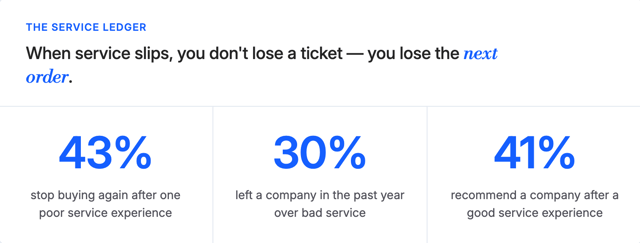
That's why a single weak interaction travels so far. A poor service experience is enough to stop 43% of consumers from buying again, and that isn't a hypothetical risk you're hedging against, because 30% walked away from a company in the past year for exactly that reason. So when service slips, you're not losing a ticket. You're losing the next order, and usually the customer behind it.
The upside is every bit as concrete, and it's the half that most teams forget to count. Get service right, and those same customers turn into your cheapest acquisition channel: 41% say they've recommended a company after a good service experience. That's the real reason this work is worth the effort. It decides whether a customer quietly leaves or brings you the next one.
What most teams miss is that the experience rarely breaks on tone. It breaks on context, the order, the carrier scan, and the last conversation that nobody is answering can actually see. That's the first and most important fix.
01. Fix the context gap before the skills gap
Start with the question that reframes everything else: which fix actually moves the needle first? For most online brands, it's order status, the familiar "where is my order," because WISMO makes up the single largest slice of support volume, somewhere between 20% and 50% of all contacts, and it climbs higher every peak season. Each one costs roughly $5 to $25 to handle once you count agent time and overhead, so the bill adds up fast. The reason it dominates is structural, not bad luck. Every order you ship is a potential status question, so the queue grows with your sales rather than with anything going wrong.
Sit with what that means for a moment. A large share of your team's day goes to a question that already has one correct answer sitting in your carrier data. That makes it a routing problem far more than an empathy problem. The shopper feels left in the dark, the agent rebuilds a tracking timeline by hand across three tabs, and both walk away worn down by something a system should have surfaced in a second.
So the first improvement most brands need isn't a coaching workshop. It's giving every person and every AI agent the same source of truth: the live order, the real carrier event, and the customer's last conversation. That single, unified view is the foundation a shipment-tracking platform builds to improve customer experience, since it pulls every order and carrier into one place instead of leaving the answer scattered across systems. If you want to understand what drives those status questions in the first place, our breakdown of strategies to cut WISMO inquiries is worth reading alongside this. The payoff compounds beyond support, too, since Salesforce found that teams working from unified channel data are 1.4x more likely to call their AI rollouts very successful than teams stuck with siloed systems.
02. Build the core skills, but train them on real order scenarios
Don't skip the human skills, because they carry the moments no system will ever handle for you. But don't run generic skills training either, because it falls apart the second a real order is on the line. Train these four the way your team will actually use them, anchored to what's happening in front of them.
Anchor your empathy to the order
Saying "I understand your frustration" on its own won't land, and here's why: your customer already feels like a number. Salesforce found that 61% of them think most companies treat them exactly that way, so a warm-but-empty reply just proves the point. Give them the fact instead. "I can see your order's been stuck at the Bengaluru hub since Tuesday, and that's on us to chase" does more than any sympathy script, because they can verify it. Understanding what proactive customer service looks like in practice can help your team make this shift from reactive empathy to evidence-based reassurance.
Listen for the real issue before you solve
When someone writes "this is the third time I'm asking," treat it as a thread problem, not a fresh question. Train your reps to restate the issue and pull up the order first, before they reply. It stops them from re-answering a case the customer already explained on another channel, which is the fastest way to turn mild annoyance into real anger.
Read the shopper, then adapt.
Some people want the tracking link and nothing else. Others want you to reassure them. Teach your team to spot the difference fast, and run drills where new information drops mid-conversation, so they learn to change course without fumbling. That flexibility is what separates a scripted rep from a trusted one.
Say it like a person.
Write the way you'd actually speak: "your order is on its way," never "shipment manifest created." When something goes wrong, walk them through what happened, what you're doing, and what's next. Do that and you answer their next question before they have to ask it, which is what keeps a delay from becoming a ticket.
If you're putting real structure around these roles, start with our breakdown of what a customer service manager and an e-commerce support specialist actually own.
03. Go proactive: kill the ticket before it exists
The best ticket is the one nobody ever opens. So stop trying to answer WISMO faster and start making sure your customer never has to ask. The logic is simple: a question you prevent costs you nothing, while every one you answer costs you something. AI workflow automation is what makes this prevention scalable across high order volumes without adding headcount. If order-status questions are eating your queue, this is where you claw the time back.
Set an accurate delivery date at checkout
Tell people when their order will actually arrive, before they pay. Your ecommerce checkout is the right place to surface a realistic delivery promise, because getting the expectation right up front closes the gap where anxiety and the "where is it?" message usually creep in. For a deeper look at how to calculate that promise accurately, see our guide on how to calculate expected delivery dates.
Send updates at the moments that matter
Don't make them come looking. Ping them when the order ships, when it's out for delivery, and when it lands, on the channel they actually open. Our guide to effective delivery notifications walks through the cadence worth using. If your customers are on WhatsApp, our guide to delivery tracking notifications on WhatsApp shows how to put those updates on the channel they already check.
Flag the delay before they notice it
This is the one that earns the most trust, so don't skip it. Silence during a delay is the single biggest reason people open a WISMO ticket, because silence lets them imagine the worst. Get ahead of it with a plain "there's a hold, here's what's happening and when to expect it," and you turn a moment of worry into a reason to trust you. Our full breakdown of shipping delays covers the most common causes and how to communicate through them.
Catch failed deliveries early
Watch for address issues and stalled shipments and act on them before they harden into a return. Understanding how handling failed delivery attempts proactively works in practice can help your team stay ahead of NDR situations before they ever reach your queue, which matters more than most teams realize, since NDR and RTO drive a big chunk of your support load.
04. Make every channel one conversation, not five
Picture one shopper over a single week. He asks about sizing on web chat, gets a price-drop nudge on WhatsApp two hours later, places his order, then emails to check on delivery. To him, that's one relationship. To most support stacks, it's five strangers, and he has to explain himself from scratch every time. Don't make him do that, because it pushes him toward the exit. Data found that 56% of customers regularly have to repeat themselves to different reps, and a few things wear a customer down faster.
So stop thinking about omnichannel as "be on more channels." Build it as one memory carried across all of them. The recommendation you made on chat should shape the WhatsApp follow-up, and the order placed on WhatsApp should already be on screen when the delivery email comes in. For a practical look at how to build this kind of continuity, our guide to multichannel customer support is a good starting point. That continuity is the thing a channel-by-channel chatbot simply can't hold, and it's exactly what we built into Ally so the conversation stays one thread across chat, WhatsApp, email, and voice. Brands using WhatsApp API for ecommerce have found it particularly effective for keeping post-purchase conversations on a single, familiar thread.
05. Map your post-purchase journey and rip out the friction
Walk your own journey before you fix anyone's skills, because for an online brand the friction almost never sits before checkout. It hides in the stretch after, where your marketing goes quiet and the customer is just waiting. That's where small gaps do the most damage, so audit each handoff like a customer would feel it.
Checkout to confirmation
Read your own confirmation page and ask: Is the delivery promise clear and honest, or vague enough to set up a complaint later? Vague here means a ticket in three days. How you present the estimated delivery at this moment has a direct effect on how many status questions arrive three days later.
In transit
Can the customer see where their order is without leaving your site, and do they hear from you when something changes? If the answer is no, you're handing them to the carrier's tracking page and hoping for the best. A branded tracking page keeps them in your experience and gives you control over what they see and when.
Delivery to returns
Make starting a return obvious and self-serve, because a clunky returns flow doesn't just frustrate people, it spawns a whole second wave of tickets: "where's my refund?" That reverse-WISMO is every bit as costly as the original kind, and it's just as preventable. The right returns management software can make the whole post-purchase loop self-serve and dramatically reduce that second wave.
Fix these, and you're not polishing service; you're removing the reasons people need it. This is the window where loyalty is actually won or lost, and it's where most "customer service" outcomes are really decided before a ticket ever opens. Our deep dive into the post-purchase experience goes deeper if you want to map yours properly.
06. Use AI to lift your team, not replace it
Don't chase a higher self-serve rate for its own sake. There's an easy way to fake it: wear customers down until they give up and close the chat. The rate climbs, but the customer is gone.
Use AI for what it's good at instead. Hand it the grounded, repetitive, low-stakes questions, so your people stay free for the cases that need a human. Our guide to AI in ecommerce customer service covers where the technology genuinely adds value and where it still needs a human backstop.
The industry's already moving here, and the reasons hold up. 79% of service leaders call AI investment essential, because volume is growing faster than they can hire. 90% say it improves the customer experience, since a fast, accurate answer at 2 a.m. beats a slow one at noon. And AI is set to resolve half of all service cases by 2027, up from 30% in 2025.
That last shift is the one to plan for. The predictable half of your queue is about to stop needing a person. So decide on purpose what your team does with the time it frees up.
Here's the payoff when you do. Hand off the repetitive volume, and 65% of teams say they finally get room to build real customer relationships. That's the shift redefining ecommerce call center services right now: less time reciting tracking numbers, more time on the conversations that actually grow retention. Tools like AI agent assist give human reps real-time order context and suggested responses, so the time freed by automation goes into genuinely better conversations rather than faster script-reading.
Then hold one hard line, because this is where AI creates risk. Your agent should only answer what it actually knows. An AI that invents a return window or guesses a fabric-care instruction isn't a win, it's a liability, because a confident wrong answer gets trusted and acted on.
So set two non-negotiables. Ground every reply in your real catalog, policy, and order data, so there's nothing to make up. And build a clean escalation: the moment a case carries emotion, a messy policy edge, or real ambiguity, it goes to a human with the full thread attached.
07. Close the feedback loop, then send it to the right team
Feedback is useless until it changes something. So don't let it pool in a dashboard nobody opens.
Run a post-purchase survey and a CSAT after the interactions that matter. Pair your NPS with a simple "why?", because the score tells you a problem exists, but only the reason tells you how to fix it. Then tag everything by theme, so patterns surface before they pile up. A customer service audit checklist is a useful companion here, because it gives you a structured way to turn raw feedback into actionable gaps rather than just themes on a slide.
Now, here's what most companies miss: A lot of what looks like "service" feedback is really an operations problem in disguise. A rising WISMO rate isn't a coaching gap, it's a tracking or notification gap. A pile of "the size was wrong" tickets isn't a tone problem, it's a product-page or returns problem.
Ignore that, and nothing improves. You drill agents harder on a WISMO spike they can't control, or coach tone on a sizing complaint that was never about tone, and the same tickets keep coming.
So route each signal to the team that owns the cause. Tracking gaps go to ops, sizing complaints go to product or returns, and nothing gets dumped back into the support queue by default. Our overview of ecommerce automation shows how teams connect feedback signals directly to operational workflows so that the routing happens systematically rather than depending on someone remembering to forward an email.
Do that, and the problem gets removed instead of re-answered. You stop seeing the same tickets next quarter, which is the loop that builds loyalty, because you're fixing causes, not clearing symptoms.
Your first 30 days
Don't do all seven at once. Run them in order, since each clears load for the next.
1. Measure your WISMO share: Divide order-status tickets by your total, because anything over a third means your fix is communication, not headcount.
2. Turn on milestone updates and an accurate delivery date: The fastest, cheapest win there is, since people only ask "where is it?" when you leave them guessing.
3. Move tracking onto your own branded page: A confusing carrier page sends them back with a ticket, while your own ecommerce order tracking page lets them self-serve and stay in your brand.
4. Put order, carrier, and conversation context on one screen: Most handle time is just the rep rebuilding a story your systems already hold.
5. Pilot AI on grounded, high-volume questions only: That's where it's reliable, and measure resolution and CSAT together so you know you actually helped, not just closed the chat.
6. Build the feedback-to-operations loop: Tag it, route it to the team that owns the root cause, and review monthly, because feedback left in a dashboard changes nothing.
Frequently asked questions (FAQs)
What does good customer service look like for an online store?
Good ecommerce customer service is resolving a shopper's question accurately and quickly from the real state of their order, not a paraphrase of a policy page. That means whoever replies can see the order, the carrier status, and the last conversation and act on all of it in one place. Empathy and clear language matter, but they only work on top of that because you can't reassure someone about a delivery you can't see.
What causes the most customer service tickets for online stores?
WISMO ("where is my order"), because every order you ship is a possible status question, so the queue grows with sales, and the answer already sits in your carrier data. The benefits of automated shipment tracking become clearest here, since surfacing that answer automatically is what stops the question from becoming a ticket in the first place.
How do you improve customer service without hiring more agents?
Prevent the questions, with accurate delivery dates, milestone updates, a self-serve tracking page, and early delay alerts, then give agents one screen so the rest move faster.
Can AI replace human customer service agents?
No, it clears the grounded, repetitive volume so people handle the emotional and ambiguous cases, which is exactly when a customer wants a human, not a script.
How do you measure customer service improvement?
Resolution, reopen rate, CSAT, and WISMO share, watched together, because reopen rate exposes an agent that hits its numbers by wearing people down.